Wednesday, 29 June 2016

Adebayor's 2006 Togolese teammates to play against 2016 Sparrow Hawks in honour of Keshi

Stephen Keshi as coach of Togo in 2006
Two generations of the Sparrow Hawks will line up in honour of their former coach who died on June 8 during a memorial game in Lome on Sunday
Players from the 2006 Togolese national team will face off against the 2016 side in a memorial match in honour of former coach Stephen Keshi who died on June 8 aged 54, Sportmasta has confirmed.
Keshi led the tiny nation to qualify for its first ever World Cup in Germany with little-known striker Emmanuel Adebayor leading the charge.
The former Arsenal and Real Madrid striker will lead his team mates from that era to face the present Hawks on Sunday at the Stade Municipal in Lome.
The game is organized by the country’s sports writers union, Association des Journalistes Sportifs du Togo (AJST).
Aime Ekpe, president of the union, said that the game is being organized in conjunction with the country’s sport ministry in honour of the Nigerian tactician.
“The game is between players of the team that Stephen Keshi qualified for the 2006 World Cup like Emmanuel Adebayor and the present generation of the national team,” Ekpe told Sportmasta .
Gates will be thrown open for fans to come in and pay their respects to the former defender whose first of two tenures in charge of the Sparrow Hawks took their country into the big leagues.
Ekpe also informed Goal that the Togolese Football Federation (FTF) is in talks with the Nigeria Football Federation to hold a commemorative international match in honour of Keshi.
“Negotiations are taking place and the match would be played either in Lome or in Lagos,” said Ekpe.
The game will be played at 15:30 GMT (16:30 in Nigeria).

Lagos State plan farewell testimonial for Keshi and Shuaibu

.
The Centre of Excellence in conjunction with the Supporters Club and Lagos Swan are planning a goodbye game for the fallen heroes
The Lagos state government in partnership with the Sports Writer’s Association of Nigeria and the Nigeria Football Supporters Club have fixed a Lagos Farewell Testimonial for deceased former Super Eagles handlers, Amodu Shuaibu and Stephen Keshi.
The game will hold on July 23 at the Teslim Balogun Stadium, Lagos.
The Lagos SWAN team will face the Supporters Club while the Super Eagles will battle the Lagos All Stars team in the main match of the day.
Keshi captained the Super Eagles to win the 1994 Africa Cup of Nations title and also led the team to win the same tournament – thus becoming the second man after Egypt's Mohamed El Gohary to achieve such feat.
For Shuaibu, he led the country to two World Cups before passing away as the technical director of the Nigeria Football Federation.
Chairman of the event’s committee Dr. Rafiu Ladipo, president-general of the Nigeria Football Supporters Club said proceeds from the game would be given to the families of the departed icons.

Maradona puts the final touches on World Cup masterpiece

Maradona puts the final touches on World Cup masterpiece
The genius No. 10 capped possibly the best tournament ever seen from one individual with a pass to Jorge Burruchaga that sealed glory, and he was inseparable from the trophy
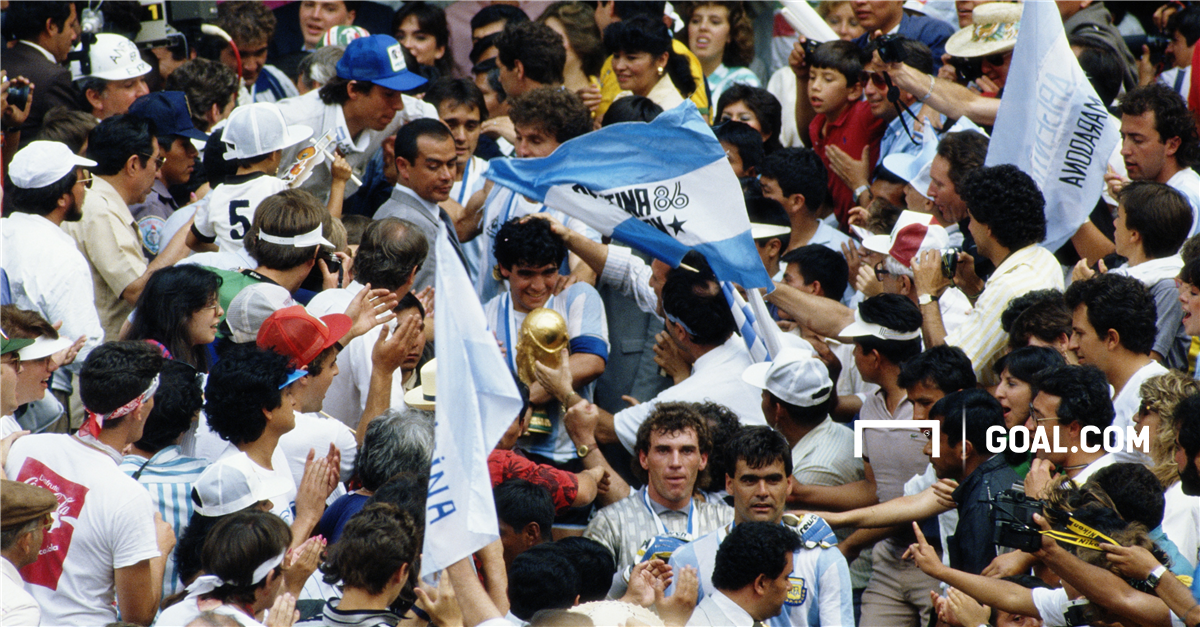
He is not alone on the balcony. FIFA directors and the president of Mexico crowd round his stocky frame, trying to whisper into his ear. Ahead gathers an army of photographers who will try to capture their own immortal image of the moment. All around him, the screams and cheers of fans.

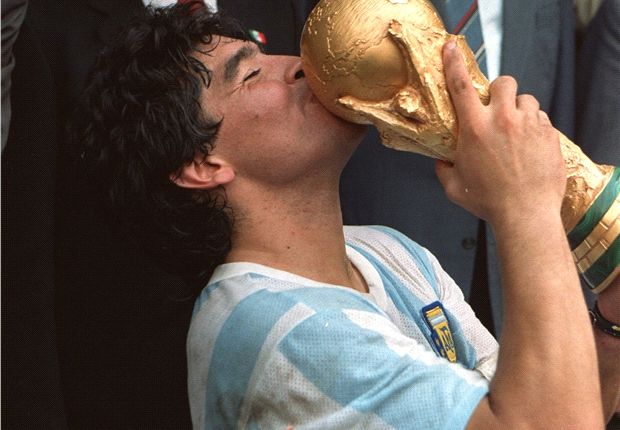
But for the diminutive figure who has the eyes of the entire world bearing down him, this is a tango for two. The World Cup and Maradona. As his team-mates pass through, he lends the trophy to them. But he never takes his gaze off it, not for a second, he feels it is his and nobody else's. Everyone understands the rules of the game: they can touch the cup, kiss it, but it must always make its way back into the hands of the No. 10.

Maradona deserved the World Cup more than anyone else. On June 29, 1986, the captain of the Argentine national team put the finishing touches on his masterpieces against West Germany, although the incessant pressure of the European battlers meant he could not shine like earlier in the tournament. In the absence of those magic moments, however, he took care of other business: he drew markers away so that others could break through and make the difference.

Maradona knew that this was the time to keep it simple. He knew when he would need to hold the ball up and keep the clock running, as his side spent almost the entire match ahead on the scoreboard.

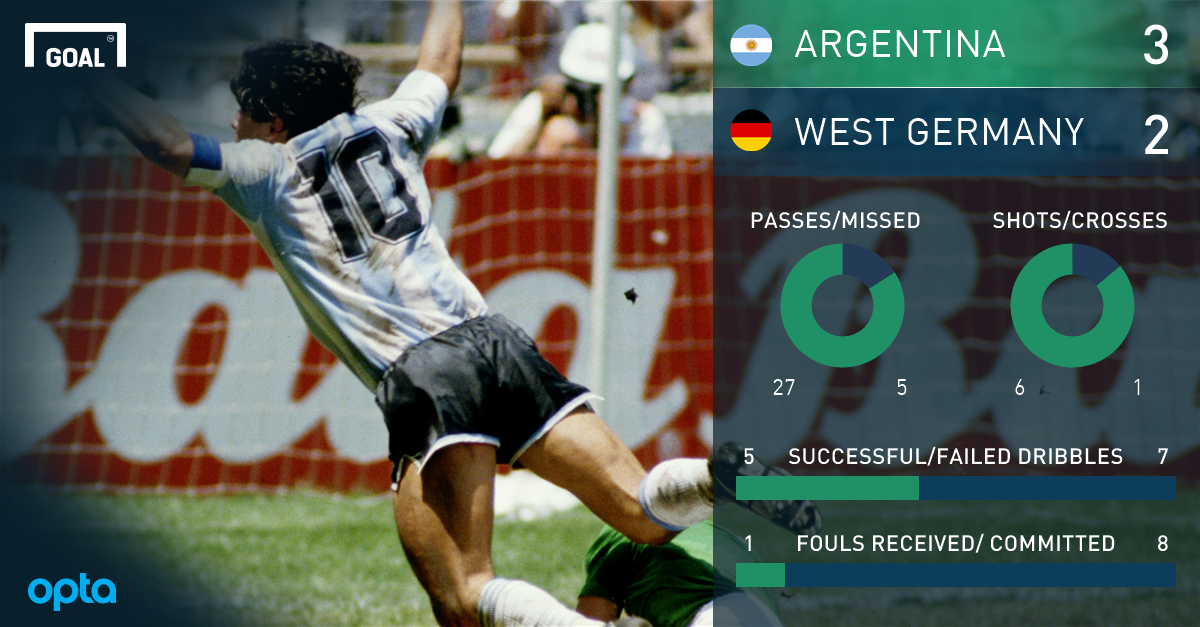
In the 3-2 victory over West Germany, Diego closed out a perfect tournament. Never in World Cup history had one player proved so decisive. That is why the figure who did not want to cede the trophy to anybody else in the moment of victory so aptly represents what he meant to Carlos Bilardo's team. He was a superstar that made everything happen and showed, one step at a time, that he was from another planet.

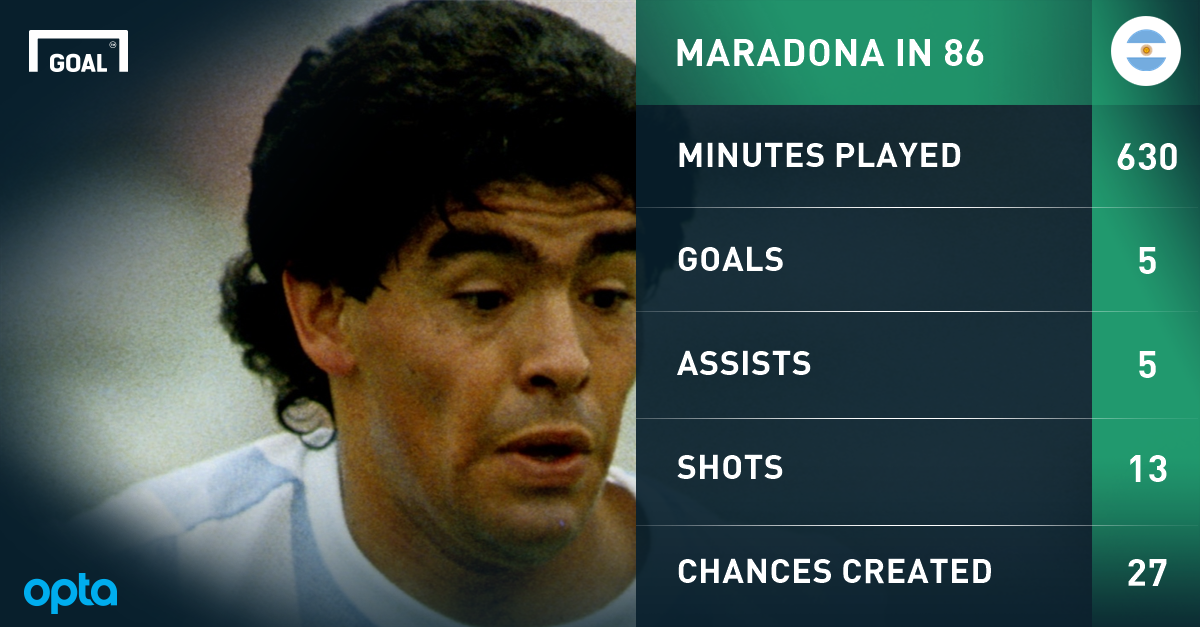
There was one big difference between Maradona and the rest: when the Argentina captain took the ball there was no room for mistakes. As well as his immense talent, he went into Mexico with the express intention of causing as much harm as possible to the opposition. Be that with a slick back-heel, a mazy dribble or a shot on goal, it rarely failed to make an impact. The numbers Maradona posted in 1986 tell the story of an unstoppable force, from start to finish.

Against the Germans, Maradona showed only part of his overall repertoire. His superhuman physique was on display as he took all the punishment the final opponents could throw at him to always be ready to attack one-on-one, or recover following a failed attack and track back with his team-mates to win possession. Around him was a team designed to support him.

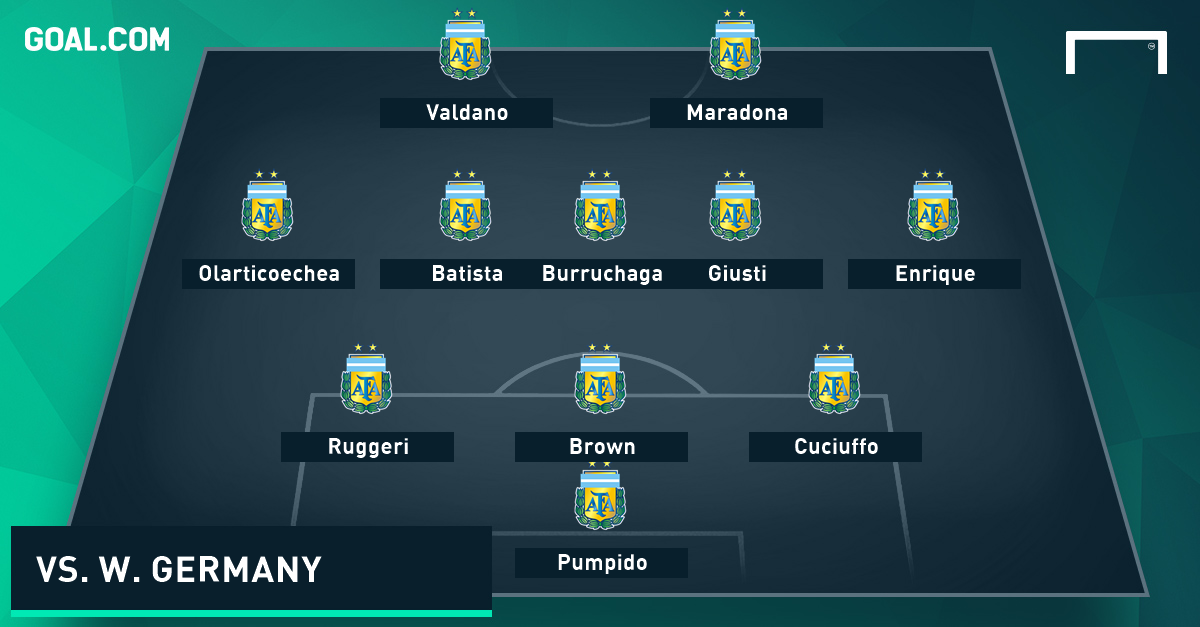
Players like Hector Enrique and Sergio Olarticoechea down the wings, drawing out defenders, playing with central midfielders that made a virtue out of simplicity - Sergio Batista and Ricardo Giusti. To finish off this perfect combination was the team's brain, Jorge Burruchaga, who gave the side balance and looked always to Maradona with the ball. It was a devastating mix.


In Mexico Maradona showed frightening technical superiority. He had an ability to break through that was too good to be true. In 1986 teams had only just started to press in the opposition half, and West Germany coach Franz Beckenbauer had a very specific plan: stop Diego at all costs.

Lothar Matthaus stayed on his coat-tails the entire match to suffocate his creativity. Karlheinz Forster waited for him as he wriggled out of the first dribble. Ditmar Jakobs stayed behind ready to sweep up if his fellow defender failed to stop the Argentine genius, never taking his eye off the dangerman. The strategy worked well, forcing Maradona to give up possession a tournament-high 26 times.

Did that make it Maradona's worst match of the World Cup? Not at all. In the final, the most important game of all, Bilardo's team showed their champion's mettle. Jose Luis Brown carried on playing with a broken shoulder. Jorge Valdano was ready to keep running until he fainted. Burruchaga was more precise and alert than ever. And Maradona was hellbent on winning. The pass to Burruchaga to make it 3-2 sums up his creativity: even in a game where he had been shut down and almost marked out of the game, he inspired the Albiceleste with an assist that made history.

Maradona was right. He was not selfish, he simply did what he had to do. The World Cup was his own, it belonged only to him. Even today, 30 years later, nobody has dared to challenge his mantle, and nobody has come close to repeating his performance in Mexico. As time passed, the photos and videos the captain with football's most-prized trophy went down into national folklore. The World Cup wanted to be with Diego, and they made a perfect couple.

Done deal? Batshuayi goes Chelsea mad on Instagram


Done deal? Batshuayi goes Chelsea mad on InstagramThe Premier League club reportedly saw a €40 million offer for the striker accepted on Tuesday and the 22-year-old moved quickly to pledge his new allegiances online


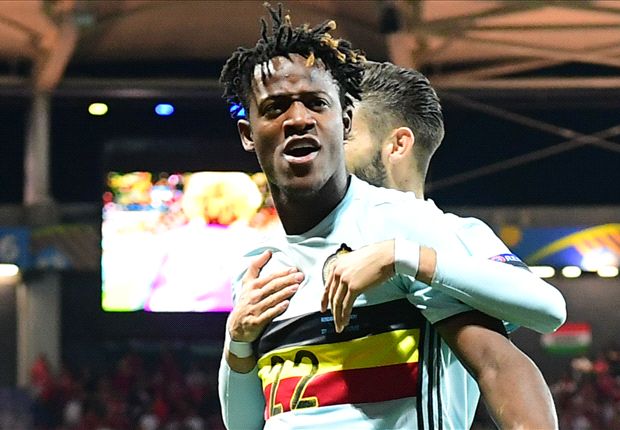
Michy Batshuayi has had a busy few days, it's fair to say. After being linked with Tottenham and Juventus before the end of the season, the striker looked set to join Crystal Palace earlier this week.

Alan Pardew saw a stunning €38 million bid accepted by Marseille, only to be trumped hours later by Chelsea who have reportedly stolen a march with a €40m offer.

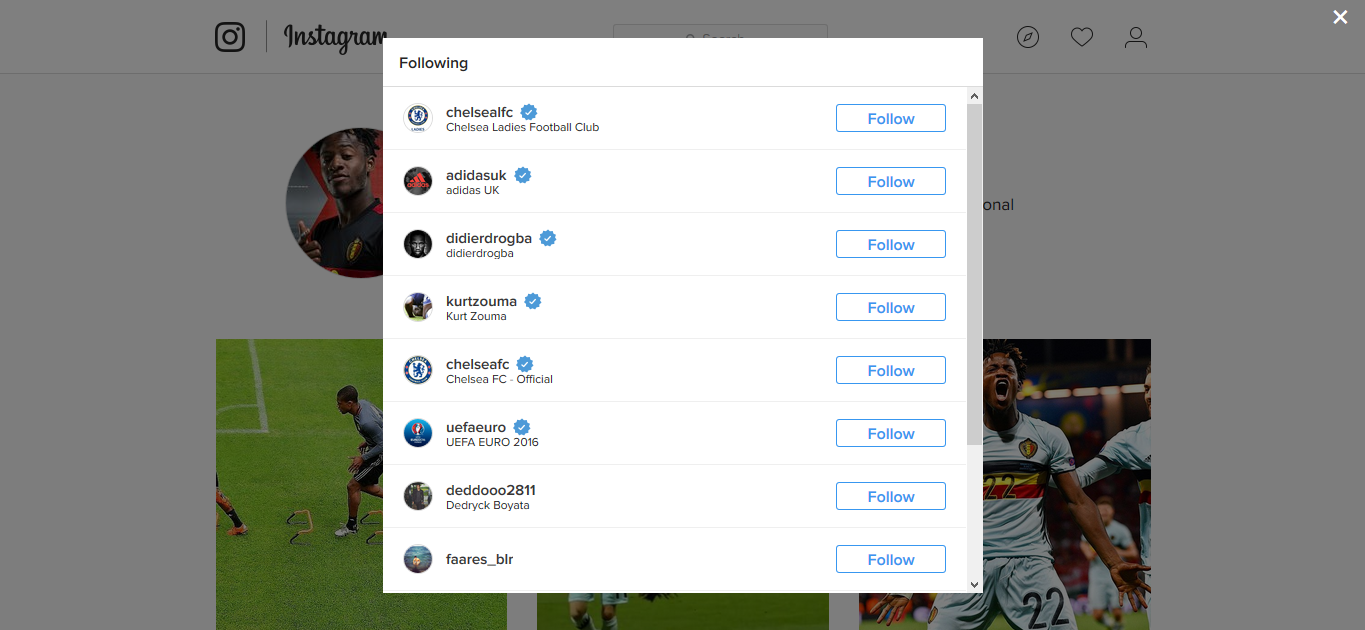
It appears Batshuayi is not wasting any time adjusting to his proposed new surroundings if his recent activity on Instagram is anything to go by.

Bayshuayi has recently followed current Blues player Kurt Zouma, legend Didier Drogba, sponsor Adidas and the Chelsea Ladies team.

Bayern begin Bundesliga title defence against Werder Bremen

Bayern begin Bundesliga title defence against Werder Bremen
The German champions kick-off the new season at home on Friday August 26 while Borussia Dortmund take on Mainz and Borussia Monchengladbach host Bayer Leverkusen
Carlo Ancelotti's first Bundesliga match in charge of Bayern Munich will see the defending champions take on Werder Bremen at Allianz Arena.
The German top-flight announced its full schedule for the 2016-17 campaign on Wednesday, with Bayern hosting Bremen to kick off the campaign in a Friday fixture on August 26.
Ancelotti has replaced Pep Guardiola following the former head coach's move to Manchester City and takes over a team who won the league by 10 points last season.
Last season's runners-up Borussia Dortmund are at home to Mainz, while the pick of the opening fixtures sees Borussia Monchengladbach host Bayer Leverkusen as the teams who finished fourth and third respectively last season go head-to-head.
Promoted club Freiburg start at Hertha Berlin, while RB Leipzig's first Bundesliga match having risen through the leagues will see them travel to Hoffenheim.
Bayern's first match against rivals Dortmund will take place at Signal Iduna Park on matchday 11 between November 18 and 20.
The return match will take place on matchday 28 at the Allianz Arena between April 7 and 9, with the late-season clash potentially a crucial one in the title race.
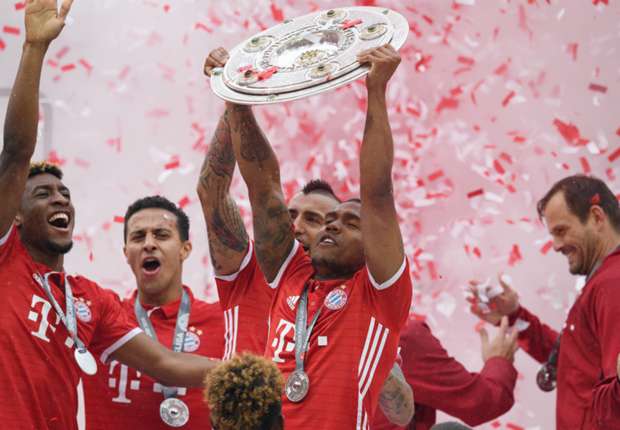
Bayern have won 26 league titles – a record – with last season's success making them the first team to win four in a row.
Bundesliga 2016-17 opening day fixtures:
Bayern Munich v Werder Bremen
Borussia Dortmund v Mainz
Borussia Monchengladbach v Bayer Leverkusen
Hertha Berlin v Freiburg
Cologne v Darmstadt
Hamburg v Ingolstadt
Augsburg v Wolfsburg
Hoffenheim v RB Leipzig
Eintracht Frankfurt v Schalke

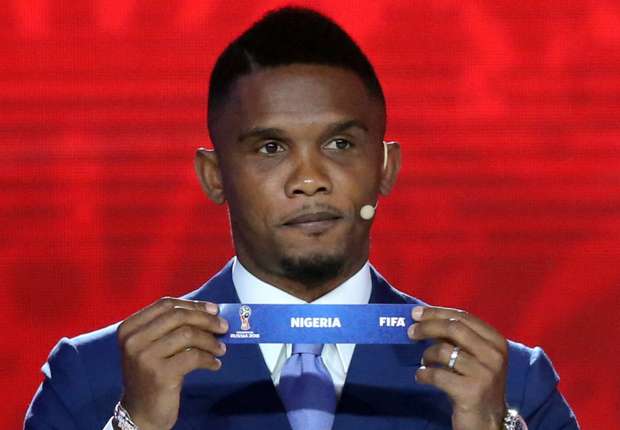
Nightmare scenario for Nigeria; hope in World Cup qualifying.

Samuel Eto'o
The Super Eagles have been pooled in the Group of Misery for World Cup qualifying after Friday’s draw

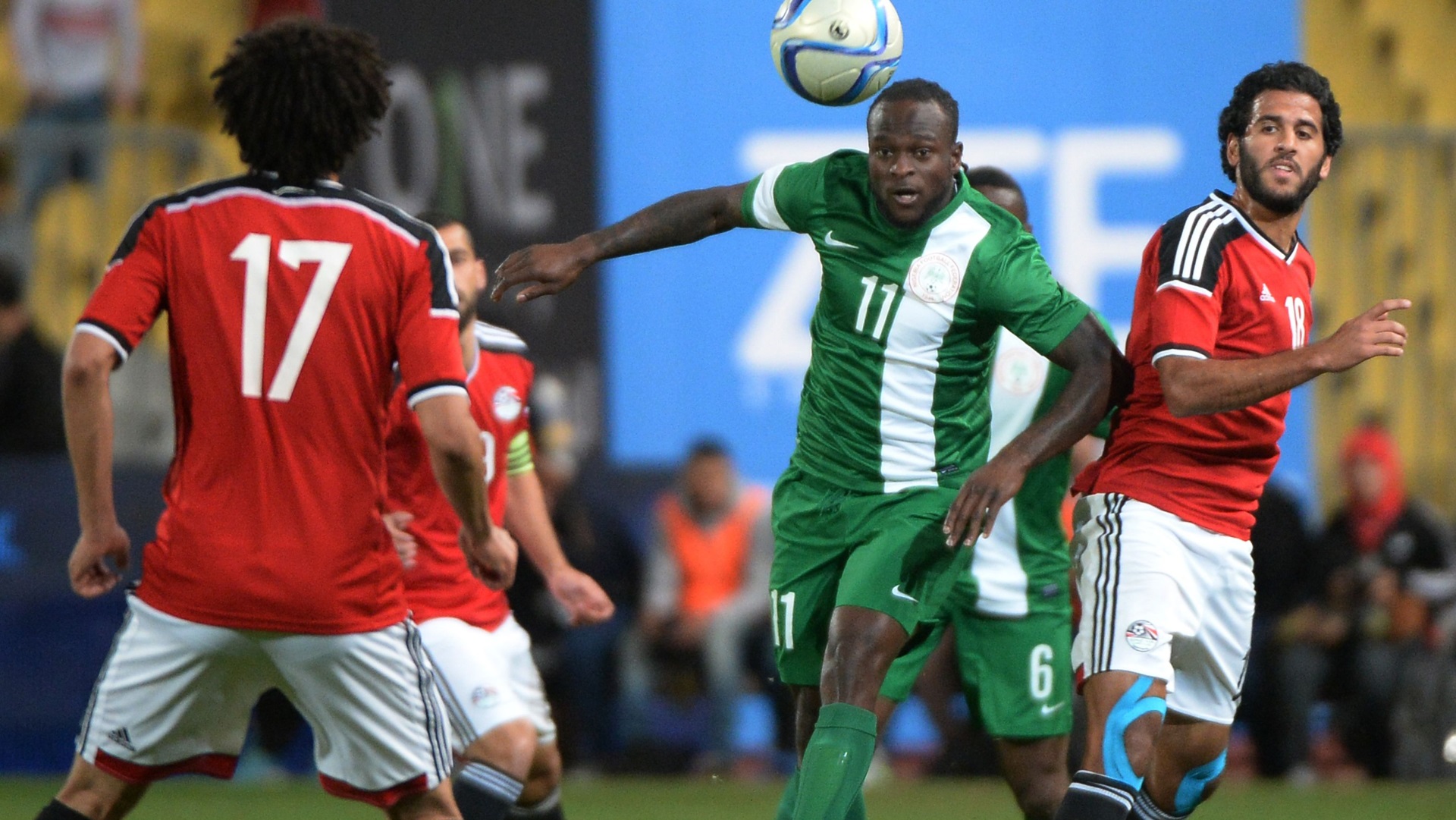
Any hopes Nigeria had of an easy World Cup 2018 qualifying draw to help get the nation’s football back on its feet were shattered on Friday when the Super Eagles were drawn in an ominous group containing Algeria, Cameroon and Zambia.
All four sides are former African champions—with a combined nine titles between them—while the three giants have a combined 16 World Cup qualifications between them, a heritage unparalleled by any other group.
The Fennecs and the Indomitable Lions were the top seeded sides in Pot One and Pot Three respectively—therefore representing the toughest possible draws—while Zambia still boast some vestiges of the squad that won the Cup of Nations in 2012 and will at least trouble their rivals for points.

Nigerian football is in the midst of a period of darkness, despite the recent optimism that comes in the form of several wonderkids who have started making their mark in the national side.
The recent deaths of Stephen Keshi and Shuaibu Amodu sent the nation into collective mourning, while the West African giants have seen their continental standing dented after missing out on the last two Afcons.
The consequence was a spot in Pot Two and the chance—wholly realised—of a testing group stage draw


Salisu Yusuf’s side will need to hope that they can exploit an Algeria in transition following the departure of coach Christian Gourcuff, with a long-term successor for the Frenchman yet to be appointed.
The North African heavyweights may have the kind of balance and wealth of options that few can manage, but Yusuf and his staff would do well to watch the tapes of Algeria’s 3-3 draw at Ethiopia in Match, when one or two weaknesses were exposed.
Cameroon have struggled to ignite in a fairly friendly Cup of Nations qualifying group, although the presence of Vincent Aboubakar up top—not to mention a talented support cast—will test a young Super Eagles side in transition.

In contrast to Nigeria, whose Afcon hopes they shattered, Egypt may be broadly confident about their chances of reaching Russia, and will surely be glad to have avoided another rendezvous with arch enemies Algeria after the drama of WC 2010 qualification.
With Uganda and the Republic of Congo drawn out first into Group E, Egypt were fortunate to have been pulled out of the hat into a favourable pool.
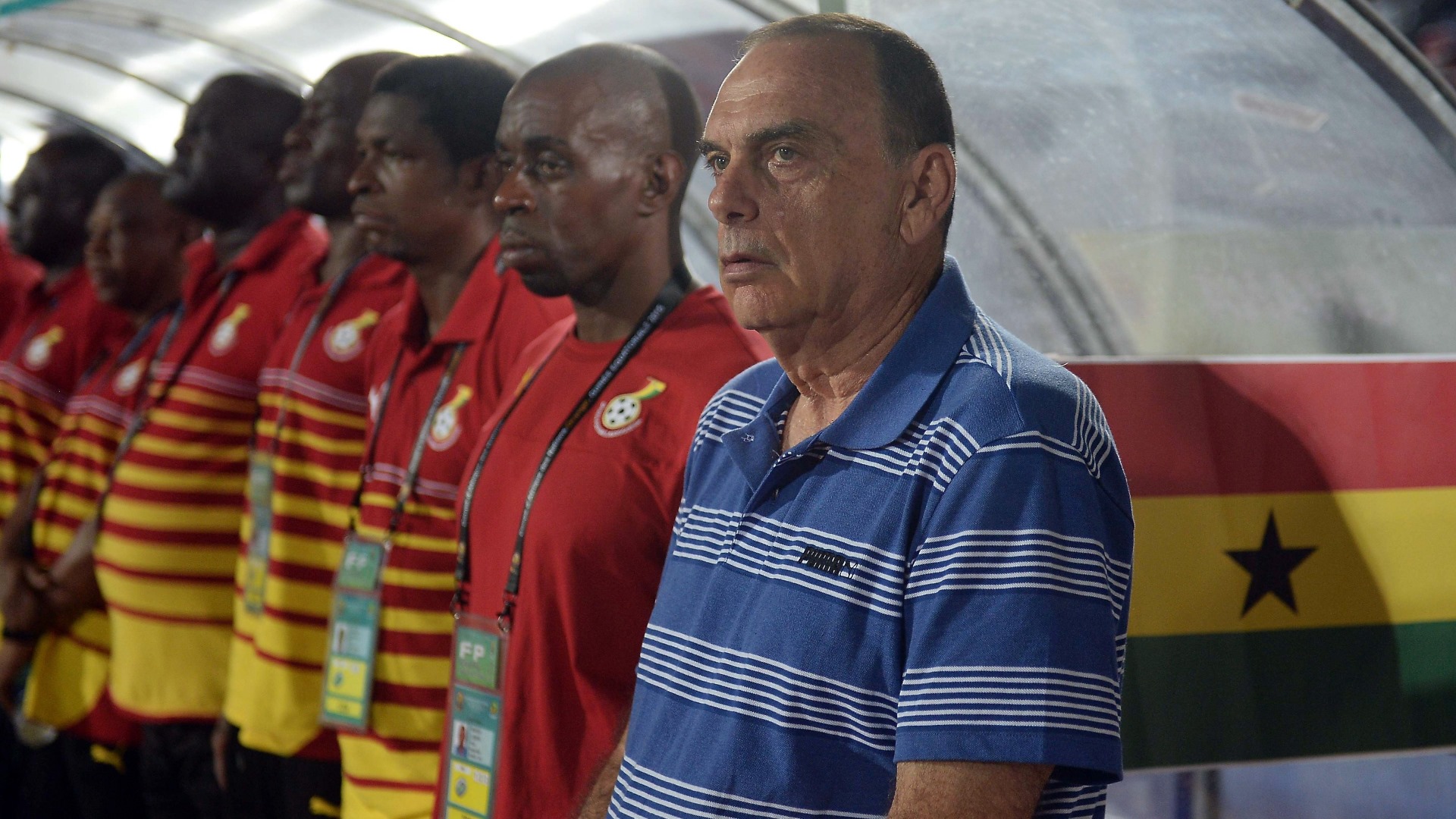
However, while they will have been happy with their lot, Hector Cuper’s emerging side were swiftly joined in their four-team group by Ghana, their nemeses ahead of the 2014 World Cup.
The Black Stars, then under the tutelage of Kwesi Appiah, turned to some of their returning stars to demolish the Pharaohs in the play offs for the last Mundial, and while that policy ultimately led to disappointment and acrimony in Brazil, Ghana have traded out the controversy but lost the star power as well.

However, Grant is quietly overseeing a steady improvement with the West African heavyweights—who will be one of the favourites to win the Afcon in 2017—and they should fare better than Nigeria did against Egypt.
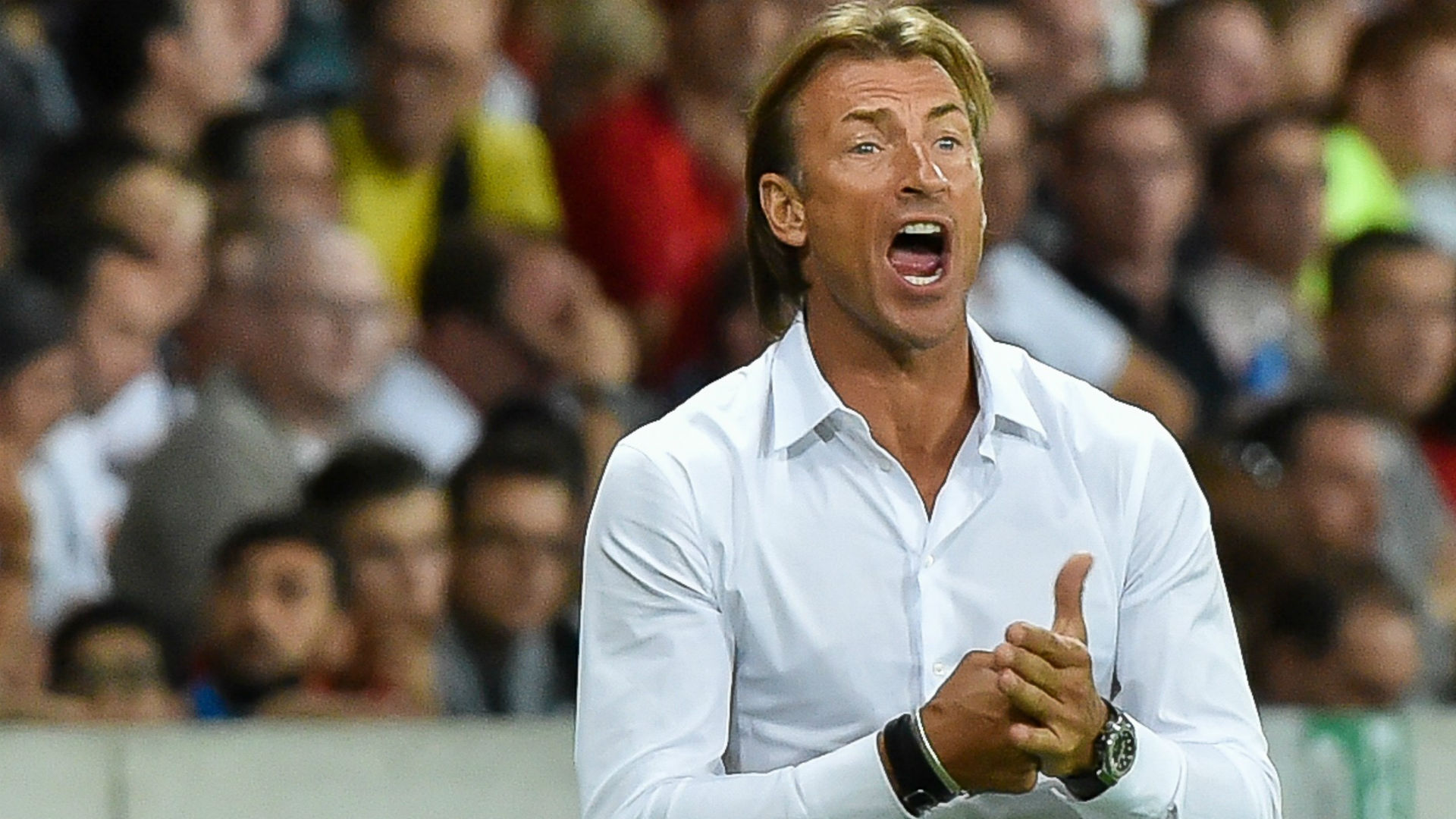
Group C offers the tantalising prospects of Herve Renard’s reunion with the Cote d’Ivoire.
Only 18 months ago, the enigmatic Frenchman oversaw the Elephants run to the Cup of Nations title—as the final remnants of the Golden Generation finally secured the success that had previously eluded them—before embarking on an ill-fated spell back in French football with LOSC Lille.
After being given the boot from the Stade Pierre-Mauroy, Renard returned to Africa, now charged with overseeing Morocco’s resurgence.

The North Africans’ double header with the Elephants promises to be tantalising, not least because—unlikely during his time with Lille—Renard has the offensive class at his disposal to truly trouble the defence he once constructed.
Mali are not the force they once were, while the tricky draw might have given a talented but unconvincing Gabon side too much to do as Pierre Emerick Aubameyang looks to take the Panthers to their first-ever World Cup.
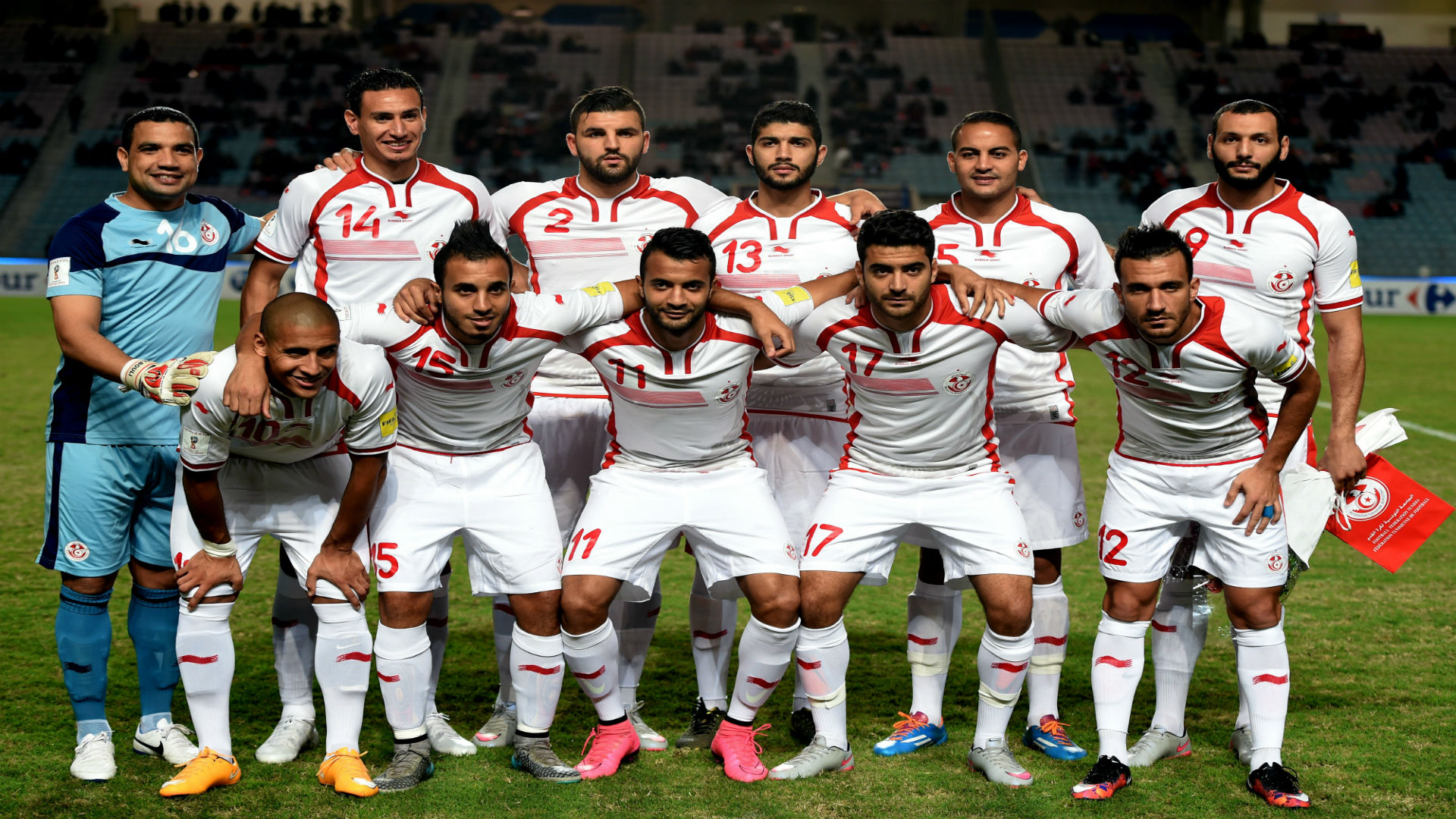
Tunisia, looking to return to the high table for the first time since 2006, were perhaps flattered by their top-seed status, but will be confident of justifying their spot with a top finish in Group A.

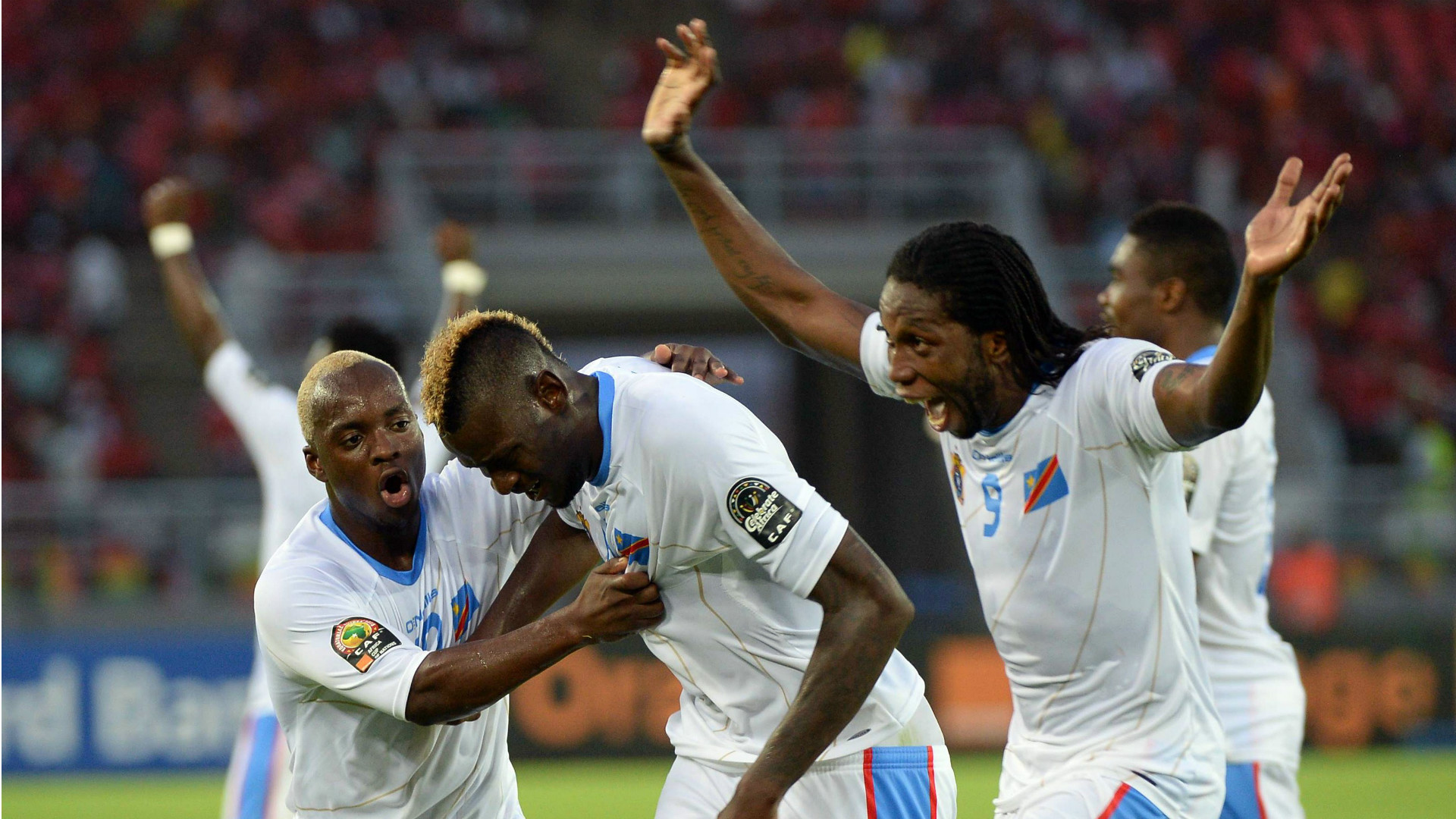
Guinea and Libya have done little in Afcon 2017 qualifying to suggest that they can challenge for the top spot, although the favourable draw could give the Democratic Republic of Congo—who took bronze at the 2015 Afcon—a chance to end their almost half-century wait for a World Cup comeback.
Florent Ibenge has plugged the Congolese diaspora to great effect, making the Leopards a real threat to overhaul Tunisia.
Finally, of all of the teams who began the day among the third seeds, South African can arguably feel the happiest with their lot.

Confidence is high with Bafana Bafana following a thumping 4-0 victory at the Gambia inspired by young prospect Keagan Dolly and Orlando Pirates frontman Thamsanqa Gabuza which put a positive spin on a frustrating Afcon qualifying campaign.
Shakes Mashaba’s side have been drawn alongside Cape Verde and Burkina Faso, both of whom have taken major strides in the last four years.
However, recent evidence suggests they may have peaked, having managed zero wins in a combined six matches at the 2015 Afcon, despite some more recent improvements.
Senegal, the group’s top seeds, are an ominous threat and are able to call upon offensive options that are largely unparalleled across the continent.
Mashaba’s side can take solace from their recent 0-0 draw against Cameroon, as they neutralised their opponents’ threat on the day, and this group offers Bafana an ideal opportunity to prove that they are not losing ground on their continental rivals.

Monday, 27 June 2016

Wimbledon: Britain's world number 775 Marcus Willis qualifies for main draw

Marcus Willis
Wimbledon on SPORTMASTA
Venue: All England Club, London Dates: 27 June - 10 July
Live: Follow on BBC TV, BBC Radio and online with further coverage across Red Button, Connected TVs and BBC Sport website.
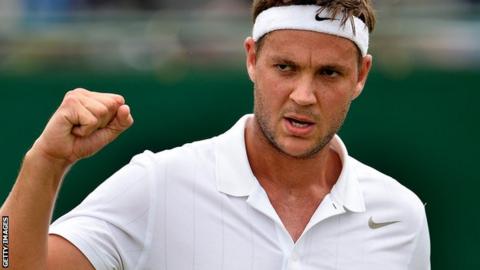
Britain's Marcus Willis, the world number 775, has qualified for the main draw at Wimbledon.
Willis, 25, beat Russia's Daniil Medvedev 3-6 7-5 6-3 6-4 in the final round of qualifying.
The Slough-born British number 23 is the 15th British player to reach the singles draws.
Fellow Briton Edward Corrie missed out on qualifying after losing 7-6 (7-5) 7-6 (7-4) 7-6 (7-3) across two days to France's Albano Olivetti.
World number 448 Harriet Dart became the final Briton to exit qualifying as the 19-year-old succumbed to Russia's Ekaterina Alexandrova in a marathon final set, losing 2-6 7-5 13-11.

Andy Murray in Wimbledon title-winning form, says Jamie Delgado

Image result for Andy Murray
Former champion Andy Murray comes into Wimbledon in "exceptional" form, says his assistant coach Jamie Delgado.
The Scot, who won the title in 2013, starts his latest campaign on Tuesday against fellow Brit Liam Broady.
"Yes, of course he's got the ability," Delgado told BBC Scotland. "He's done it before.
"And the form he's coming in with is exceptional. So, of course, we believe he can win it. He's obviously had a great few months on the clay."
Murray, 29, has reached the finals of the both the Australian Open and French Open this year, losing to Novak Djokovic in both, before retaining the Aegon Championships title at Queen's Club last week on his return to grass.
Immediately prior to his four-set Roland Garros defeat, he contested the finals in Madrid and Rome with world number one Djokovic, prevailing in Italy.
"With the amount of balls that you hit, the amount of matches that he's won and the intensity that he's played at over the clay, all that will help him on the grass," said Delgado.
"And then just confirmation of that obviously at Queen's. So, yeah, he's coming in with great form and hoping to play well here."
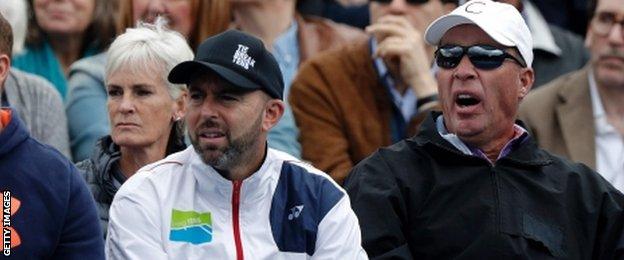
 http://ichef.bbci.co.uk/onesport/cps/624/cpsprodpb/1767D/production/_90096859_delgado_lendl_gettyjpg.jpg
For his campaign at Queen's, Murray was reunited with coach Ivan Lendl, who has stepped in after the breakdown of the Scot's partnership with Amelie Mauresmo.
Delgado says it's "been good" working with the multiple Grand Slam-winning Czech.
"He showed up on the Tuesday of Queen's, so we've been together, what is it; a week-and-a-half, nearly two weeks now?" said the 39-year-old Englishman.
"And it's been working well. We see the game in a similar way and agree on how Andy should be playing and practising."
Delgado believes it is important how Murray paces his way through the tournament to avoid what happened in Paris, where his team believes he expended too much energy in his first couple of matches and ran out of steam in the final.

'Federer's place in draw is significant'

Murray is in the more favourable half of the men's draw.
"We've talked about that," said Delgado. "You've got to respect every single opponent that you play.
"I think possibly in Paris a couple of the matches, not through lack of respect at all but rather the way the matches panned out, they took a little bit more energy out of him so that, when he got to the final, he had maybe a little bit less left in the tank, so that's something that we'll be looking to put right here."
Murray beat fellow Britons Aljaz Bedene and Kyle Edmund on his way to victory at Queen's and begins his campaign against Broady in a draw that means he will avoid defending champion Novak Djokovic and seven-time title winner Roger Federer until the final should they progress that far.
"It's very notable, obviously, that Federer's in the other half of the draw," added Delgado.
"Its weird, isn't it; we were just laughing with Andy because he hasn't played a British guy for years on the tour and then he played a couple at Queen's Club and now first round here at Wimbledon.
"Obviously he knows Liam Broady well and he'll be looking forward to that for sure."

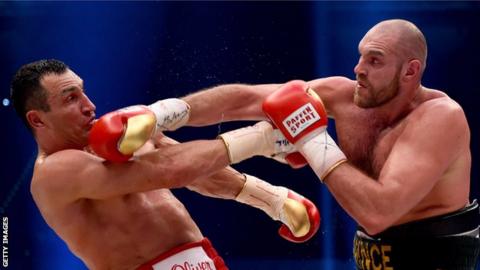
Wladimir Klitschko: Tyson Fury comments 'sounded like Hitler'

Wladimir Klitschko (left) and Tyson Fury
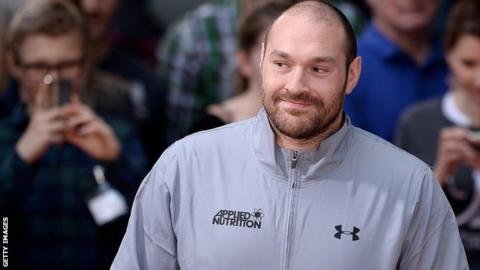
Tyson Fury should be banned from boxing for comments which made him sound "like Hitler", Wladimir Klitschko says.
Britain's world heavyweight champion apologised last month for a video he posted online containing homophobic, sexist and anti-Semitic comments.
But ex-champion Klitschko, who fights Fury in Manchester on 9 July, said: "I was in shock at his statements.
"When he got to the Jewish people he sounded like Hitler. The man is an imbecile."
The 40-year-old Ukrainian, who lost to Fury in November to suffer his first defeat in 11 years, added: "We cannot have a champion like that. Either he needs to be shut up or shut down in the ring, or just suspended, because you cannot create more hate.
"I'm fighting a guy who can't hold his mouth on certain things."
The Campaign Against Antisemitism has also called for Fury to be banned and complained to the British Boxing Board of Control.
The undefeated 27-year-old, who took the WBA and WBO heavyweight titles from Klitschko in their first bout, later said he was sorry for causing offence and promised to improve his behaviour "as an ambassador of British boxing".
He was also criticised shortly after his victory over Klitschko last year, when comments on homosexuality, paedophilia and women saw more than 100,000 people sign an online petition seeking to have him removed from the BBC's 2015 Sports Personality of the Year shortlist.

Tyson Fury postpones Wladimir Klitschko rematch due to injury

Tyson Fury
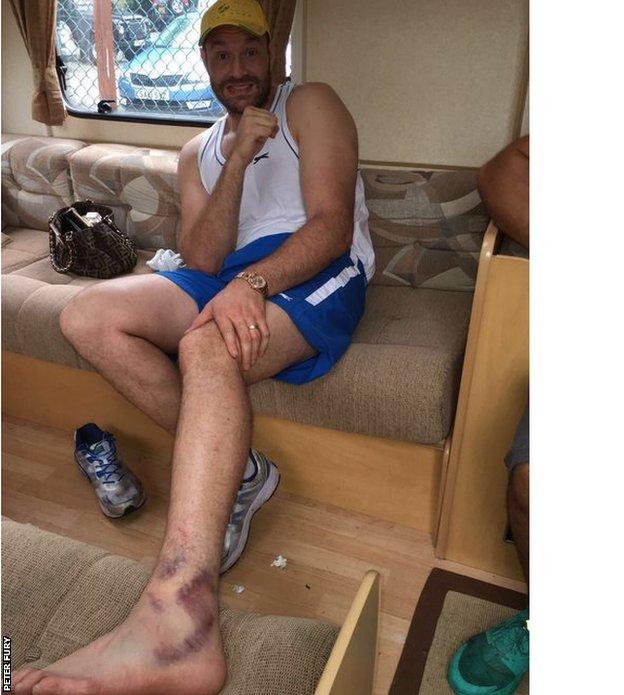
British world heavyweight champion Tyson Fury has postponed next month's rematch with Wladimir Klitschko after injuring an ankle in training.
The bout had been scheduled to take place in Manchester on 9 July.
Undefeated Fury, 27, posted on Instagram that he had been forced to cancel the fight after injuring himself while running in the Lake District.
"They've said it's not broken but it's badly sprained and to keep off it for six to seven weeks," he said.
Peter Fury, his uncle and trainer, said on Twitter: "Fight date will be postponed with new date released very soon, probably today."
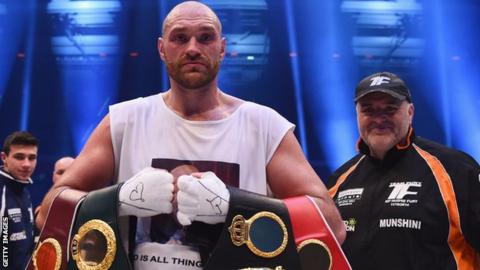
Tyson Fury took the WBA and WBO heavyweight titles from Klitschko in their first bout in November.
"Of course, I am currently totally disappointed about the cancellation," Klitschko said.
"As well as for my fans, I´m very sorry, they were all very excited for this rematch. But one thing is also clear, this just means I'll get my belt a few weeks later."
Fury's promoter Mick Hennessy added: "It's very unfortunate at this crucial stage of Tyson's preparations that this injury has occurred with just a couple of weeks to go.
"There was no way Tyson could go into the fight against Wladimir Klitschko less than 100% fit."
 Tyson Furyhttp://ichef.bbci.co.uk/onesport/cps/624/cpsprodpb/CCA4/production/_90088325_cluj9amwmaaihji.jpgTyson's uncle Peter posted this picture of the boxer's injured ankle on Twitter on Friday
 http://ichef.bbci.co.uk/onesport/cps/624/cpsprodpb/2BBE/production/_90089111_fury.jpg

Tyson Fury: Heavyweight champion denies doping allegation

Tyson Fury
British world heavyweight champion Tyson Fury has denied doping, after the Sunday Mirror said he was being investigated by UK Anti-Doping.
The newspaper says traces of a banned anabolic steroid were allegedly found in a sample given by Fury last year.
The boxer's promoter, Hennessy Sports, says it is "baffled" by the story.
Undefeated Fury, 27, this week postponed his rematch with Wladimir Klitschko after injuring an ankle during training.
Hennessy's statement said that fight, originally scheduled for 9 July, will now take place in October.
Fury beat Ukrainian Klitschko, 40, in November to win the WBA and WBO heavyweight titles.
The Sunday Mirror reports "unacceptable levels of nandrolone" were found in a sample taken from Fury in the lead-up to that fight.
Nandrolone, which is produced naturally in the body in small amounts, can increase muscle growth and reduce tiredness.
Ukad says it refuses to discuss cases "until due legal process has been completed".
The British Boxing Board of Control is aware of the investigation, according to the Sun.

F1 gossip: Hamilton, Rosberg, McLaren, Renault, Ricciardo

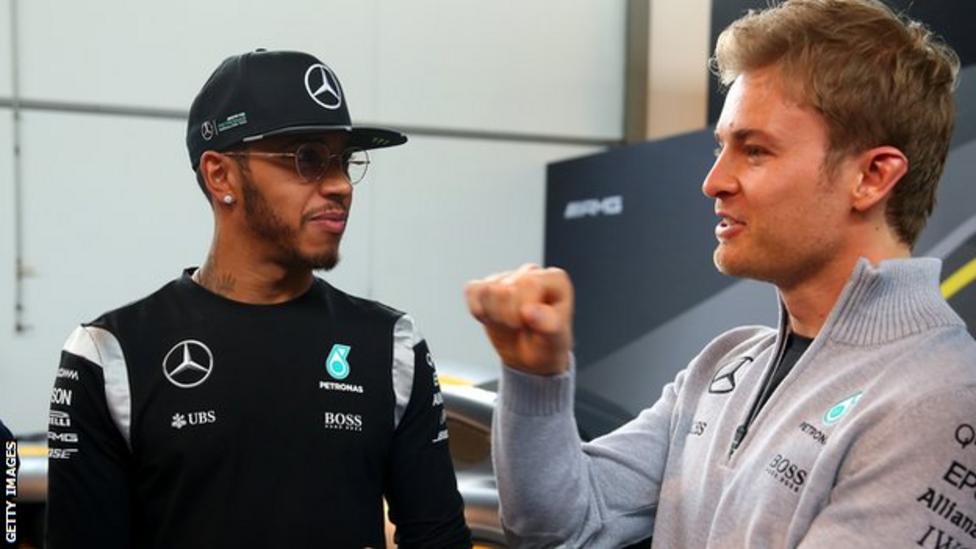
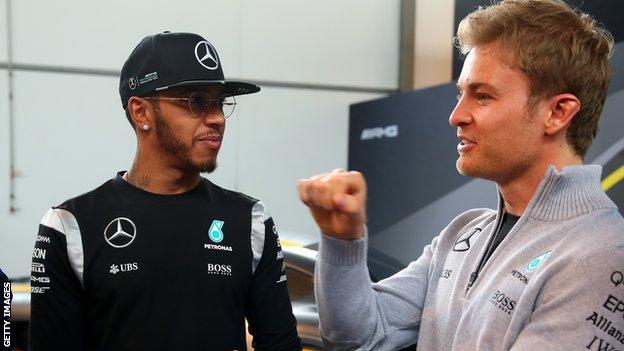
Lewis Hamilton and Nico Rosberghttp://ichef.bbci.co.uk/onesport/cps/624/cpsprodpb/10035/production/_90098556_ham2.jpg

Sunday, 26 June

Lewis Hamilton says he has a "really good" relationship with Mercedes team-mate Nico Rosberg. (Mail on Sunday)
Hamilton revealed on Instagram he has lost 5kg since the beginning of the season and wants to put weight back on.
Three races could be removed from the calendar in the 2017 season including two in Europe, according to Bernie Ecclestone. (La Gazzetta dello Sport)
The 85-year-old says Britain leaving the European Union will make no difference to F1. (Reuters)
McLaren team boss Ron Dennis says a decision on their 2017 driver line-up will not be made until September at the earliest. (Sky Sports)
Fernando Alonso believes McLaren are the team with the best chance of toppling Mercedes. (Autosport)
Four-time world champion Alain Prost says there is no quick fix to Renault's problems. (NBC)
Team boss Cyril Abiteboul says Renault need to target improving their "qualifying and aero". (Foxsports)
Red Bull driver Daniel Ricciardo says the problems he had last season have made him stronger. 

Saturday, 25 Junehttp://ichef.bbci.co.uk/onesport/cps/624/cpsprodpb/17AD3/production/_90097969_rosbegr.jpg

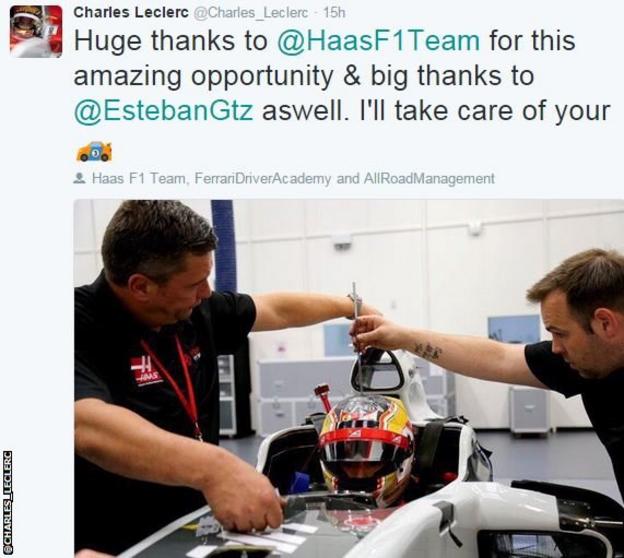
Monaco-born teenager Charles Leclerc will replace Mexican Esteban Gutierrez in Friday first practice sessions at five Formula 1 races for Haas this season, starting with Silverstone next month. (Reuters)
The 18-year-old tweeted his appreciation after learning the news.http://ichef.bbci.co.uk/onesport/cps/624/cpsprodpb/A74D/production/_90092824_leclerc.jpg

Drivers who avoid penalty points in lower series competition will be given a 'Safety Bonus' - an additional two points on top of their achieved points towards the F1 superlicence. (Pitpass)
Renault have to reassess how they progress in Formula 1 following three poor races, according to the team's managing director Cyril Abiteboul. (Autosport)
Ferrari team principal Maurizio Arrivabene insists the team are not already looking to next season, with Sebastian Vettel currently 24 points behind second-placed Lewis Hamilton. "After eight races I think it is wrong to think of the next year, leaving aside the present. We are approaching the Mercedes, and we must not miss the chance offered in this world championship," he says. (Motorsport.com)

Friday, 24 June

Four-time world champion Alain Prost thinks Ferrari must consider the "ambience" of the team when deciding whether to drop Kimi Raikkonen for 2017. (ESPN)
The Brazilian Grand Prix at the Autodromo Jose Carlos Pace circuit, will remain on the Formula 1 calendar for many years to come, race organisers have said, amid reports the event could be dropped at the end of the current season. (Grand Prix Times)
Pirelli has confirmed the three tyre compounds that will be available to the teams at the next races in Spa and Suzuka. The Italian tyre manufacturer will bring its supersoft, soft and medium compounds to Belgium - a combination that has been chosen for five of the eight races to date. (Formula1.com)
Baku organisers are not keen to turn the Azerbaijan event into a night race, despite the wishes of Bernie Ecclestone. (Fox Sports)
Formula 1 will reach record-breaking speeds and lap times under the new 2017 regulations, according to Ferrari's F1 technical director James Allison. (Formula1.com)
Spanish Grand Prix winner Max Verstappen, 18, says he has now learned he can sometimes drive at "92%" in Red Bull's Formula 1 car rather than pushing as hard as he did with Toro Rosso. (Autosport)
Formula 1's television coverage has been slammed as a "disaster" by Alain Prost, who reckons current camera angles and onboard footage are not doing justice to the spectacle. (Motorsport.com)
McLaren team-mates Jenson Button and Fernando Alonso are joined by veteran screen diva Dame Joan Collins, with Button commenting on Instagram: "Dame Joan looking lovely as always."

Thursday, 23 June

Ferrari driver Sebastian Vettel, 28, says F1 must tread a fine line between danger and safety to ensure it retains its raw appeal to fans. (ESPN)
Williams' deputy team principal Claire Williams says the team have "got to do better" as they chase third in the constructors' championship standings. (Sky Sports)
Williams have revealed their record-equalling pit stop at the European Grand Prix was actually faster than official timing claims. (Motorsport.com)
Ferrari technical director James Allison says his team's early work under the 2017 regulations is already producing a better looking car for next season. (ESPN)
F1 needs more tracks like new European Grand Prix venue Baku, says Mercedes motorsport chief Toto Wolff. (Autosport)
Pirelli has announced the tyre choices made by each team for the Austrian Grand Prix, with a small difference in compound allocations for Mercedes team-mates and title rivals Nico Rosberg and Lewis Hamilton. (Eurosport)

Wednesday, 22 June

Sunday's European Grand Prix, where Lewis Hamilton finished fifth after technical problems, has given the Briton "a lesson in humility", says former F1 driver Jean Alesi. (Autoweek)
Kimi Raikkonen says he has no problem with being asked to move over and let Ferrari team-mate Sebastian Vettel pass him in Baku. (Fox Sports)
Jean Todt, president of Formula 1's governing body FIA, has rejected calls for teams to be able to give drivers technical information over team radios during races. Todt adds that the F1 cars are not as complicated as those that competed in Le Mans 24. (Eurosport)
Ferrari's Sebastian Vettel says the team "are moving in the right direction", despite them not winning any of the races so far in 2016. (Gazetta World)
McLaren's Jenson Button is happy at finishing 11th at the European Grand Prix because the result in Baku came at "their worst circuit of the year". (ESPN)

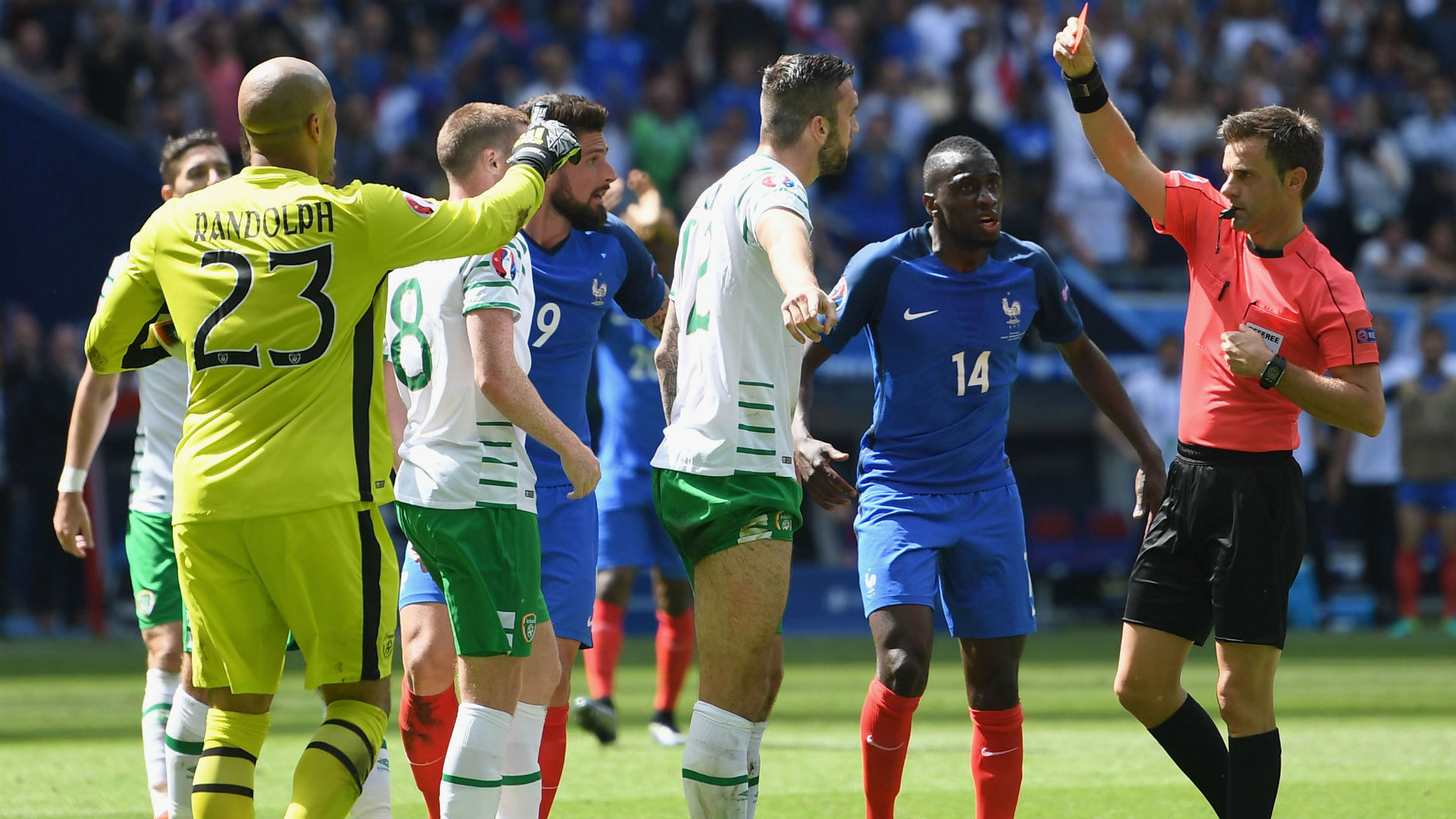
O'Shea defends Duffy after red card against France

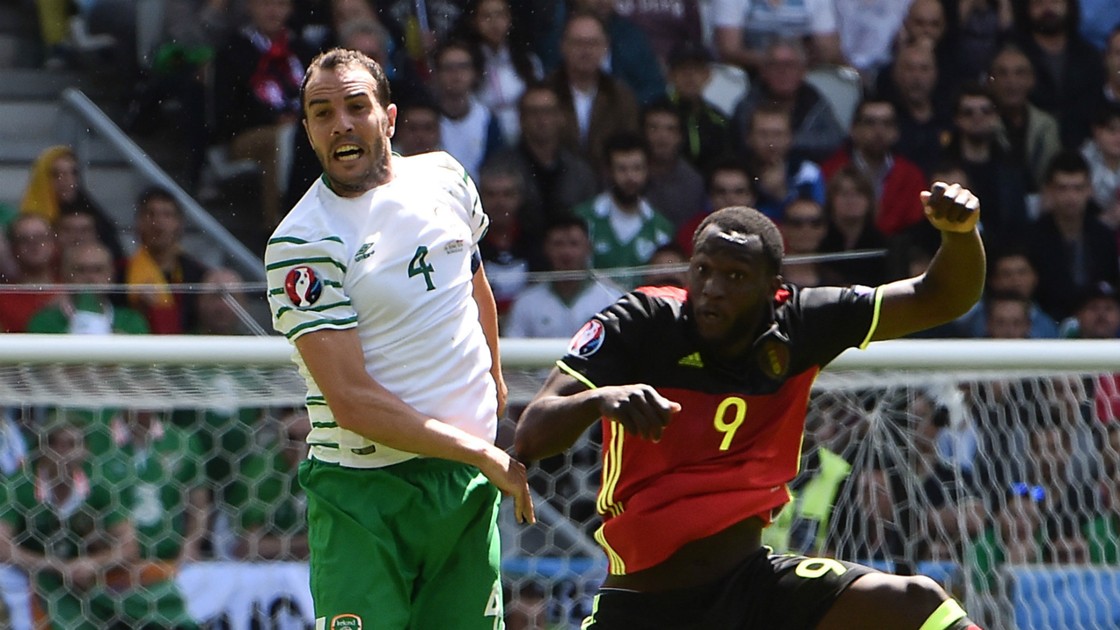
http://images.performgroup.com/di/library/GOAL/87/52/john-oshea-republic-of-ireland-romelu-lukaku-belgium-18062016_sfavqndvuv361gm66n1fluvdx.jpg?t=1676804765&quality=90&h=630
The Sunderland centre-back praised the 24-year-old, insisting that his decision to foul the Atletico Madrid attacker kept the Boys in Green in the game
John O'Shea is adamant that Shane Duffy had to foul Antoine Griezmann and take a red card in the Republic of Ireland's Euro 2016 last-16 encounter with France.
The Boys in Green succumbed to a 2-1 defeat at Parc Olympique Lyonnais on Sunday, with Griezmann striking twice in quick succession after the re-start to cancel out Robbie Brady's opener.
Their task was made considerably more difficult when Duffy was dismissed for a foul on Griezmann that denied the Atletico Madrid forward a goal-scoring opportunity on the 66th minute.

However, O'Shea believes that Duffy's foul "kept [Ireland] in the game" and said that the Blackburn Rovers centre back was "outstanding".
"Shane had to make that decision [to foul Griezmann]. It kept us in the game," the former Manchester United defender told reporters. "Tonight he was outstanding - he relished the situation.
"Himself and Richard - not only the centre-backs but across the pitch - the effort and quality they showed at times was brilliant to see."
O'Shea had to make do with a place on the bench against France, but was introduced to shore up the backline after Duffy's dismissal, making his 114th appearance for Ireland.
Having turned 35 in April, the Waterford native is approaching the end of his career, but he refused to be drawn on his international future.
"I'm not going to get involved in that now," O'Shea said when asked if he would make himself available for the 2018 World Cup qualifying campaign.
"I'm going to enjoy tonight with a special group of players and a special backroom staff and coaching staff.
"It's very different, especially when we had that moment with the fans in the corner - that's something I'll cherish for a long time."
Ireland kick off their World Cup qualifying campaign away to Serbia on September 5.

Coleman hails "special" bond between Ireland fans and players

http://images.performgroup.com/di/library/GOAL/6e/90/dimitri-payet-seamus-coleman-france-ireland-uefa-euro-2016-26062016_13iocq1p6md0m1kghu434knwhd.jpg?t=-1931861435&quality=90&h=710
The Everton defender was sorry not to have given the supporters another game to attend and stressed the importance of their backing
Seamus Coleman has hailed the Republic of Ireland's supporters and believes that they "all played a big part" in helping the team reach the knock-out stage of Euro 2016.
Having come through a group containing Belgium, Italy and Sweden, Ireland were dumped out of the tournament at the last-16 stage by hosts France after losing 2-1 at Parc Olympique Lyonnais on Sunday.
After the defeat, the Irish players and staff remained on the pitch to applaud the fans who made their way to the game and the Everton defender stressed the importance of that "special" relationship.
"It's incredible. The bond between the players and the fans is something special," Coleman told reporters.
"Our fans are immense and we're so proud of them, as I'm sure they are of us. It means a lot to us - not just the fans who were there today, but the fans who were at the Sweden game, the Belgium game and the Italy game.
"They all played a big part. And all the fans back home watching, there is that bond. It would have been nice if we could have gone one further."
Ireland drew their opening game against Sweden before losing to Belgium, but a victory against Italy in their last group game ensured progression to the latter stage of the competition.
Despite their tournament coming to an end against the hosts, Coleman believes that the performances of the younger players in the team indicates that "the future is bright" for Irish football.
"We were probably written off a bit after the Belgium game [3-0 defeat], but I'm sure you've seen a few good young lads come through," the former Sligo Rovers defender said.
"The likes of Jeff [Hendrick], Robbie [Brady], James [McCarthy], big [Shane] Duffy as well. [They] played a big part in this tournament.
"I suppose the future is bright in terms of those young lads coming through."
Ireland now turn their attentions to qualifying for the 2018 World Cup in Russia and their campaign gets started on September 5 away to Serbia.

The secret behind the Iceland miracle

Argentina's Lionel Messihttp://images.performgroup.com/di/library/GOAL/5a/5/iceland-austria-euro-2016_ey1cpi2aqc161wgdufhcbixsq.jpg?t=2026236405&quality=90&h=630
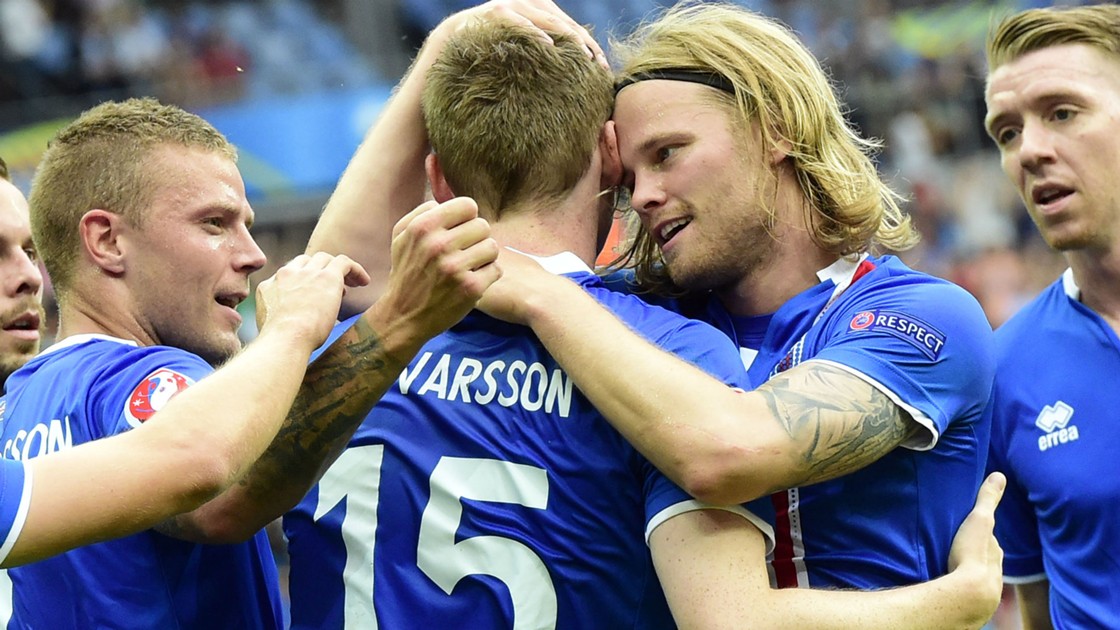
Their qualification for the last-16 is one of sport's great underdog stories but it is the result of a collective and youth-oriented football programme put in place 15 years ago


I spent one frosty week last winter driving through Iceland. Though the landscape was snow-covered, along barren highways, one thing kept popping up: small pitches and training houses, even in the tiniest of towns.
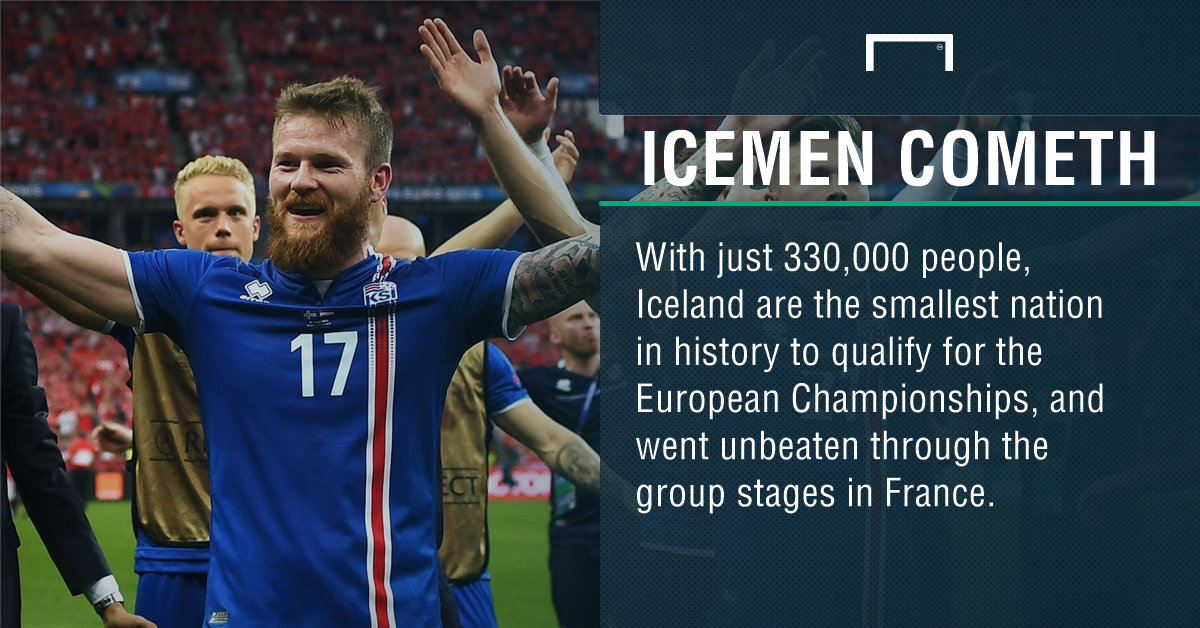
And when you think of small towns, you have to reshape your scope to an Icelandic scale. In a country of roughly 330,000 people, a small town may consist of a few houses and one shop. Iceland, a miniscule island nation largely isolated from continental Europe, features one of the lowest population densities in the world. They are the smallest country by population to ever qualify for the finals of the European Championship. By comparison, Albania, the next smallest country in terms of population at the Euros has roughly nine times as many people as Iceland.
But just like the greenhouses that dot the Icelandic landscape and have become synonymous with the country, so too do first-rate facilities for young football players to train.
It may seem strange, given that the average low temperature in the country's capital city of Reykjavik only reaches above freezing seven months of the year. Or perhaps even stranger considering that these publicly funded spaces were kept afloat even after Iceland suffered a horrific financial crisis starting in 2008. The Economist claimed that, relative to the size of the economy, Iceland's banking collapse eight years ago was the biggest that any country has ever suffered.

Those within the Iceland Football Association (KSI) and the country's club teams find nothing strange about these public training facilities, however.
According to the KSI, there were 179 full-size pitches in Iceland at the end of 2015 and one full-size pitch for every 128 registered players in the country. This is in addition to the 166 half- and mini-sized pitches throughout the country with artificial turf (six indoor and 160 outdoor).
In fact, it may very be those facilities which led to Iceland qualifying for their first ever major finals.
"Everybody can see that these pitches are vital to us," Arnar Bill Gunnarsson, the head of football development at the KSI, told Sportmasta . "If we had to cut some losses or cut some money down, it wouldn't be the houses."
Gunnarsson says that there is "no doubt" that the current squad, the first to ever qualify for a major international finals, benefitted directly from these public training houses – most of them built after 2000. The surprisingly easy access that players had to training facilities and top-rate coaching allowed them to continue their training regardless of the size of their town or the often-inclement weather outside.
According to those within Iceland's football system, it is the country's treatment of their youngsters and the importance that they place not just on development and coaching but also in ensuring equal access for all players that truly set them apart from other nations.
"One of the things in Iceland that I really like is that there is equality here. Everybody is allowed to train in football," says Gunnarsson. Long known as a bastion for socialism, few countries have the fundamentals of their society more clearly reflected in their approach to sports.
The overhaul began in 2002 when, according to multiple reports, the KSI hired Sigurdur Ragnar Eyjolfsson to be the head of coach education. The focus became establishing a curriculum and ensuring that the country could produce strong, top-level coaches - and it's an approach that is beginning to reap rewards.
"It doesn't matter if you're a boy or girl or good or bad at playing football," continues Gunnarsson. "Up until the age of 19, you can train as much as you'd like. A 19-year old who is not that good at football can still train five times a week and do physical training five or six times a week, which is unthinkable in any other country. You'd have to be in an academy and be a really good player."
That accessibility bleeds from youth programs into its top ranks. Due in part to the country's relatively small population, the highest football division in the country, the Men's Select Division (Urvalsdeild karla), is a semi-professional league. It nevertheless acts as a breeding ground for many of Iceland's top players before they leave the country to seek better economic fortunes abroad. The lack of financial compensation is a reality with which those within the Men's Select Division have long come to terms but it hasn't prevented them from producing capable players.
Take Gylfi Sigurdsson, for example. The 26-year-old Swansea City midfielder, known for his tremendous ability from set-pieces, presents a vast difference from the long-held stereotype of rugged Icelandic defenders. He spent some of his early career with Breidablik, one of the country's top sports clubs before moving on to the likes of 1899 Hoffenheim and Tottenham.
Sigurdsson progressed through the Iceland Under-19s and Under-21s squads into the senior team and was key in their Euro qualification campaign, scoring three goals in two matches against the Netherlands to help eliminate the World Cup semi-finalists.
While an Icelandic player might begin his professional career in the Men's Select Division before going abroad to play, that period of time in the Urvalsdeild karla while training in the same public training grounds as the country's youth is crucial to Iceland's football culture as a whole.
"The atmosphere itself at the clubs is very conducive to success," Dadi Rafnsson, director of coaching for the youth program at Breidablik, told SPORTMASTA.
!As a young kid, you can see older players that have gone on to play for national teams. You can see them, touch them, train with them. It's inspiring that they can actually go forth with these players.!
Throughout his career as a coach in Iceland, Rafnsson has amassed an in-depth understanding of not only the realities and challenges of producing players in an isolated environment but also the fundamentals of Icelandic football.
For Rafnsson and others within the Iceland football ranks, they've turned the supposed handicap of a small population into a weapon; the relatively small disconnect between the youth and professional ranks only further inspires children to success.
"When you have it in front of you, it's quite easy to imagine that you can be there yourself one day," he says.
The young players of Iceland cannot get there without proper training, though.
Gunnarsson is quick to point out how Iceland's approach to youth coaching is as fundamental to the national team's success as anything else. In Iceland, young players of any skill level will likely be trained by a coach with a UEFA B license. Gunnarsson says that even his four-year-old son could be taught by a coach in possession of a UEFA A license, as well as a Physical Education teaching degree.
Coaching licenses are easy to obtain in Iceland as, unlike in other countries, the KSI makes these courses available to nearly any coach who is interested in attaining them. Sigurdur Ragnar Eyjolfsson, formerly the head of coaching education in Iceland, told These Football Times that, when the country overhauled their coaching system, "it was paramount to run the courses without a view to a profit, that nothing was added on top of the fee." In 2003, according to the KSI, no Icelandic coach had completed their UEFA B license but, beginning in 2004, when the first coaches graduated, the focus towards promoting strong coaching from within the country emerged.
Since then, Iceland have enjoyed a startling rise. They are currently ranked 34th in the world by FIFA, their second-highest-ever rank and up from 50th in 2000 and an all-time low of 112th in 2010.
What's more, the roots of football culture within the country have become that much stronger.
"The kids get great experience from the training sessions, which helps them to start loving the game," says Gunnarsson. "If you start loving the game, you start playing it outside of organised training sessions. That's the important thing."
Gunnarsson estimates that it takes just eight months for anyone in Iceland to attain a UEFA B license, although that doesn't mean that the education isn't of a high quality. As with every other facet of football in Iceland, the cultural values of the country are reflected on the pitch.
"It's cheaper than in other countries," he says, listing the cost for a UEFA B license at €770 (£613). A 2013 ESPN story stated that the cost for a UEFA B license in England was £990 (and could cost as much as £2450) while the cost in Spain was €1,200 (£955).

"Ninety-five per cent of the courses are in Reykjavik so everybody gets the same teachers as well," he says.
What may seem like an overly simple approach has been on display for the world to see, with the culmination a last-16 clash against England in Nice on Monday evening.
In an age of excess within football, Iceland's approach remains an outlier. Their mpressive results at the Euros, however, may prompt other smaller nations to copy Iceland's model for success.
Argentina 0-0 (aet 2-4 penalties) Chile: Defending champs sink Messi and Co. again

Chile celebrate
Claudio Bravo made the decisive save in the shoot-out as Francisco Silva converted the winning penalty in New Jersey.
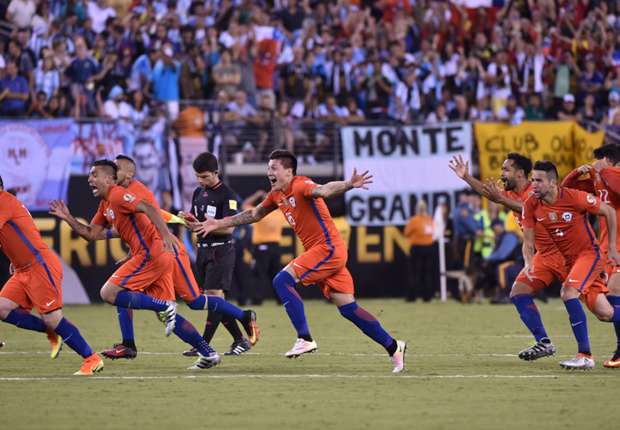
Chile made it back-to-back Copa America titles after seeing off South American rivals Argentina 4-2 in a penalty shootout in Sunday's ill-tempered final.
Both Argentina and Chile were reduced to 10 men in a fiery first half in a rematch of last year's decider, as Marcos Rojo and Marcelo Diaz saw red, and neither team could break the deadlock after 120 minutes of play in front of more than 82,000 fans at MetLife Stadium.
And for the second successive year, a shootout was required to determine a winner, with Chile coming out on top again following spot-kicks as Argentina's 23-year wait for a major trophy continued.
After captain and goalkeeper Claudio Bravo denied Sergio Aguero with a stunning finger-tip save in extra time, he was at it again in the shootout, keeping out Lucas Biglia's effort following Lionel Messi's skied shot over the bar as Francisco Silva stepped up and converted the winning penalty.
The 4-2 shoot-out loss marked a third consecutive defeat in a final for Argentina, beaten last year as well as the 2014 World Cup.
Despite concerns about Angel Di Maria's fitness, the star attacker returned to the starting lineup in place of the injured Ezequiel Lavezzi. Biglia also replaced Augusto Fernandez in midfield following the 4-0 rout of the United States.
Chile also made two changes after their 2-0 win over Colombia, with Arturo Vidal back in the XI having served a one-game suspension. There was also room for Diaz as Silva and Pablo Hernandez made way.
While Ever Banega had a chance inside the first minute, trying his luck from distance with Bravo left scrambling across his line as the ball flashed just wide of the post, the early exchanges were typical of South American football with more fouls and less action.
Despite the stop-start nature of the match, Argentina did settle quickest and loomed as a constant threat in attack and they should have been ahead in the 21st minute.
In a similar scene to the 2014 World Cup final, which Argentina lost to Germany in extra time after Gonzalo Higuain wasted a gilt-edged opportunity in the first half, the in-form Napoli striker bottled another golden chance on the big stage, pouncing on Gary Medel's slip and charging through on goal only to see his chip over Bravo drift agonisingly wide of the woodwork.
And just as Chile was left counting their blessings, things quickly turned sour for the title holders when Diaz was sent off by referee Heber Lopes approaching the half-hour mark for a second bookable offense, having blocked Messi.
With tensions simmering however, Argentina's numerical advantage was short-lived after Rojo was shown a straight red card in the 43rd minute for a tackle from behind on Vidal, sparking a melee.
The second half was somewhat subdued compared to the first, as the match opened up, but neither team really tested the opposing keepers.
Not even the introduction of Aguero, in place of Higuain, could spark Argentina as fans watched on in silence, such was the lack of action in the respective attacking thirds, though Chile star Eduardo Vargas did force Sergio Romero into a low diving save with 10 minutes remaining.
Messi engineered an opening for Aguero in the 85th minute but the Manchester City forward wasted a good chance, unable to keep his effort under the crossbar.
There was action in the remaining seconds when Jean Beausejour sprinted forward and picked out Alexis Sanchez inside the six-yard box, though he was denied by Ramiro Funes Mori's last-ditch tackle, while Messi fired a powerful shot wide of the post at the other end as the match headed to extra time.
The game came to life in the additional period, with Bravo producing one of the saves of the tournament to tip Aguero's goal-bound header over the bar and keep the scores level in the 101st minute, after Romero dealt with Vargas and his effort just moments earlier.
Both Vidal and Messi missed the opening penalties, but Chile emerged triumphant thanks to Nicolas Castillo, Charles Aranguiz, Beausejour and Silva, as Bravo's save paved the way for victory.

Several players may follow Messi into international retirement.says; Aguero

Aguero: Several players may follow Messi into international retirement
While Sergio Romero believes that the forward will reconsider and stay with the national team, the Manchester City striker says that he and others are "evaluating" the same move
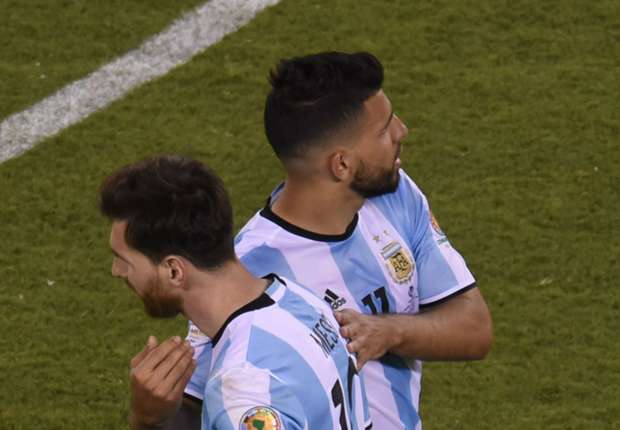
Lionel Messi may not be the only Argentina star to decide on international retirement after their Copa America heartbreak, says Sergio Aguero.
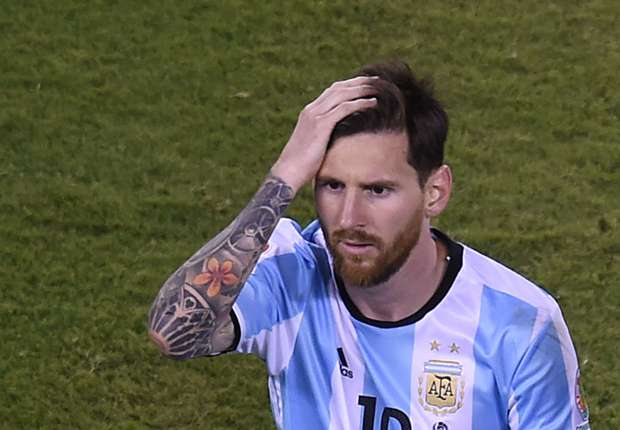
The Albiceleste drew 0-0 with Chile in the final on Sunday before a missed penalty from Messi contributed to a 4-2 defeat in the shootout, after which the Barcelona star told reporters that "the national team is over for me".
Aguero, who shared with Messi the pain of consecutive Copa defeats by Chile and the loss of the 2014 World Cup final to Germany, confirmed that the devastation of another near miss had many contemplating a similar move.
"There are several players who are evaluating not continuing with the national team," the striker told reporters. "This is the worst dressing-room I've ever been in, worse than the final in the World Cup in Brazil and the other Copa America."
Reports in South America have linked Javier Mascherano, Lucas Biglia, Ever Banega, Ezequiel Lavezzi and Angel Di Maria with international retirement ahead of Argentina's resumption of World Cup qualification in September.
Goalkeeper Sergio Romero, however, believes that Messi may come down from his decision after the initial heartbreak of Sunday's defeat wears off.
"I think he spoke in the heat of the moment because a beautiful opportunity escaped us," said the keeper. "I can't imagine a national team without Messi. I think he'll reflect on it."

Chile's Pizzi calls Messi the best of all time

Chile's Pizzi calls Messi the best of all time
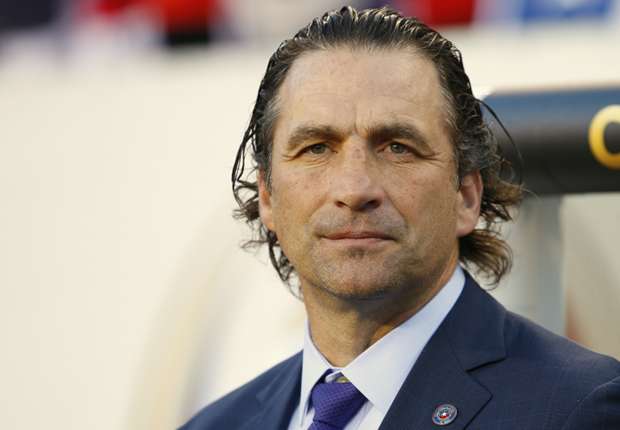
Shortly after he helped lead Chile to a second straight Copa America title, Chile coach Juan Antonio Pizzi praised Lionel Messi as the best player of all time.

EAST RUTHERFORD, N.J. — Lionel Messi may have failed to score in the fourth final of his international career, and he may have missed his penalty kick in Sunday's Copa American final, but that didn't change Chile coach Juan Antonio Pizzi's opinion of his fellow Argentine.
For Pizzi, Messi remains the best player of all time.
Right around the same time Messi was announcing his plans to retire from the Argentine national team, Pizzi was singing the praises of the Barcelona star, making it clear he feels there has never been a better player.
"On top of having an admiration for Messi, I'm driven very much by the numbers," Pizzi said Sunday. "Because I know what it means to value certain numbers and Messi's numbers are unmatched, and I don't think they will ever be matched because it's impossible for a player to find the things that Messi finds."
"The people, at times, are very particular when it comes to valuing certain things," Pizzi continued. "I do it from a point of view that's very personal — everyone should do so from a personal point of view — and in my point of view Messi is the best player of all time."
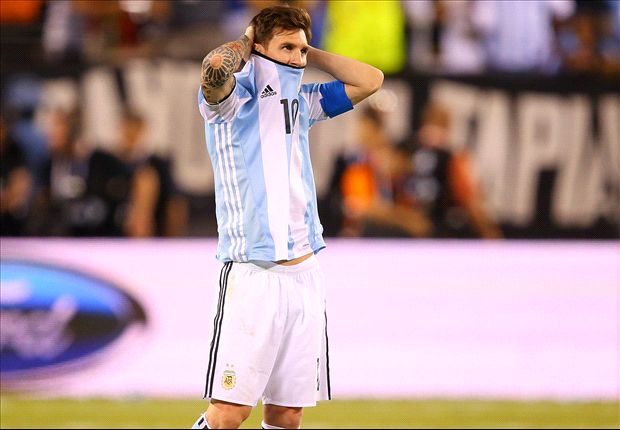
Messi's frustrations in losing a third straight major international final were clear for all to see as he shed tears after the penalty shootout loss to Chile, no doubt feeling the anguish of falling short yet again in his quest to win Argentina's first major title in 23 years. Messi has taken the bulk of the blame for that drought going on this long, as he has faced the pressure of trying to live up to the legacy of former Argentine great Diego Maradona.
"My generation can't compare (Messi) with Maradona, because of my generation, because of what Maradona did for Argentine soccer," Pizzi said. "But it seems to be the best payer in history played today here in the United States and for me the numbers are irrefutable."
Pizzi had plenty of praise for his team's successful defense of the 2015 Copa America title it won on home soil, providing a reminder of just how tough a challenge Chile faced in Sunday's Copa America final.
"That group has helped us become a strong national team, a team that can compete with the best," Pizzi said. "In front of us today we had the number one team in the world, with the best players in the world, with the best player in history, and with all the virtues I spoke about, we were able to compete."

Is Lionel Messi right to quit international football?

Is Lionel Messi right to quit international football?
The Barcelona superstar declared his intention to call it a day with Argentina after missing a penalty during a shootout defeat by Chile in the Copa America final
Lionel Messi has announced his intention to end his international career with Argentina after another heartbreaking defeat in a final, this time the Copa America on Sunday.
The Barcelona superstar missed a penalty in the shootout as Chile bested the Albiceleste once again and subsequently said that "the national team is over for me".
But is it the right call for Messi to turn his back on Argentina? Have your say in our poll!

Lionel Messi planning international retirement after Copa defeat

Lionel Messi planning international retirement after Copa defeat
The Barcelona star says that he may not represent Argentina again after missing a penalty as the Albiceleste lost to Chile in a shootout at MetLife Stadium on Sunday
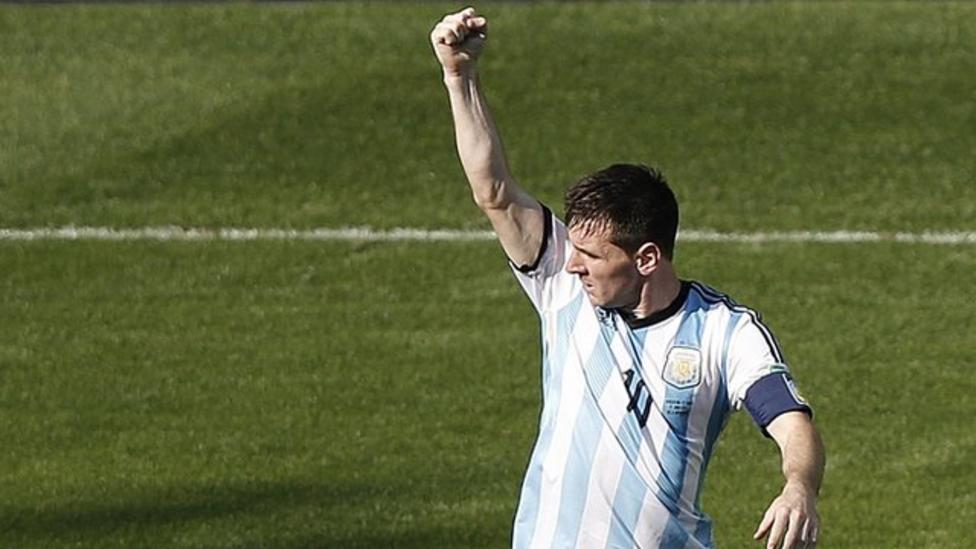
A frustrated Lionel Messi declared that he is planning to retire from international football following Argentina's loss to Chile in the Copa America Centenario final.
"The national team is over for me. That's four finals [lost]; it's not for me," Messi told reporters after losing his third final in as many years. "The decision is made, I think."
Sunday's match finished without a goal and went to a penalty shootout, with Messi missing his spot kick on the way to a 4-2 defeat.
It was the second time in as many years that Chile beat Argentina on penalties in the Copa, which itself followed the Albiceleste's loss to Germany in the World Cup final in 2014. Messi also was part of the Argentina side who lost to Brazil in the final in 2007.
Messi has been locked in a dispute with officials at the Argentine Football Association, taking his frustration to social media prior to the final, but his own performance in Sunday's final also seemed to be weighing on him after the contest.
"I feel a great sadness right now that this is happening again," he said. "I missed my penalty, which was super important. That's it."
Argentina's next matches are in World Cup qualification ahead of the 2018 tournament in Russia. Gerardo Martino's men sit third in the CONMEBOL pool after six matches.